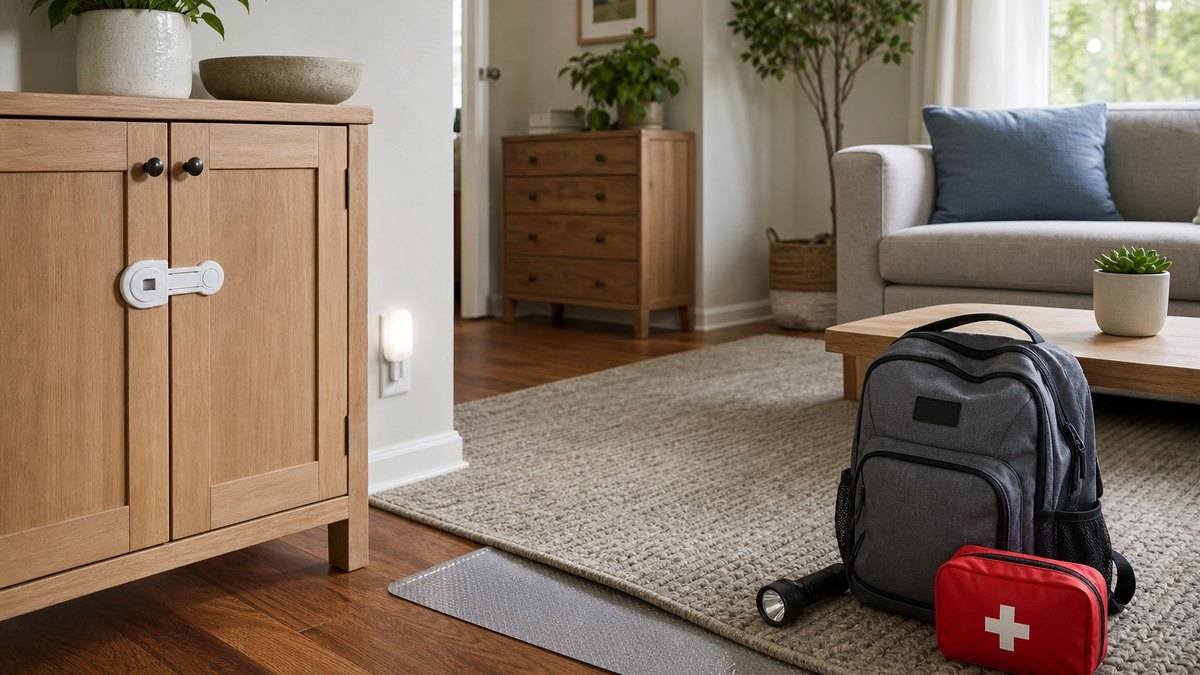
Home emergency preparedness is three layers, per Ready.gov: a kit, a plan, and staying informed. The kit splits into two versions with different sizes, the plan covers how the household reconnects, and both have expiration dates that the checklist has to manage.
The Red Cross sets the water and food math: one gallon of water per person per day, with a three-day supply for evacuation and a two-week supply for sheltering at home. Food follows the same split, three days of non-perishables in the go-bag and two weeks in the home supply.
The emergency preparedness checklist for home below runs the two-layer kit, the basic supplies list, the family plan, the unique-needs layer, and the maintenance schedule that keeps all of it from expiring.
The two-layer kit: evacuation go-bag and home supply
One kit does not fit both emergencies, and the split is the first decision. The evacuation go-bag is what each person carries when the household leaves: three days of water and food, a flashlight, a radio, batteries, a first-aid kit, and the documents and medicines that cannot be replaced. The home supply is what the household lives on when sheltering in place for two weeks: the larger water and food stores plus the supplies the go-bag only samples.
Store the go-bags near the exit or in the car, where a quick departure reaches them, and store the home supply in a cool, dry, designated location, per Ready.gov’s storage guidance. The two versions share the same contents list, but the quantities and the storage differ, and labeling both with a date makes the maintenance check possible.
Ready.gov adds the two location-specific kits: a work kit with 24 hours of supplies in case sheltering at the office is needed, and a car kit with water, food, blankets, a flashlight, and a phone charger, because a car can be a shelter during a winter storm or a breakdown.
The basic supplies list
The Ready.gov basic kit is the canonical list, and every item earns its place. Water and food first, then a battery-powered or hand-crank radio with a NOAA Weather Radio, a flashlight with extra batteries, a first-aid kit, a whistle to signal for help, a dust mask, plastic sheeting with scissors and duct tape for sheltering in place, moist towelettes with garbage bags and plastic ties for sanitation, a wrench or pliers to turn off utilities, a manual can opener, local maps, and a cell phone with chargers and a backup battery.
The full list adds the items a household cannot improvise: prescription medications and glasses, cash in small bills, copies of identification and insurance documents in a waterproof bag, a change of clothes and sturdy shoes per person, a sleeping bag or blanket, and a complete change of clothing for each household member.
The list is longer than it looks, which is why the one-afternoon build is the standard instruction: assemble the full list once, label it with the date, and the maintenance schedule takes over from there.
The family plan: reconnecting when local lines fail
The kit is half of preparedness; the plan is the other half, and the plan’s first rule is the out-of-state contact. After a disaster, local phone lines and cell towers fail while long-distance lines often still work, so the household names a contact in another state, and every member calls that contact to report their status. The contact’s number goes on a wallet card that everyone carries.
The plan’s second rule is the meeting points: one right outside the home for a fire-style evacuation, and one farther away, like a neighbor’s house or a community center, for a neighborhood-wide event. The household practices both, the same way the fire escape plan practices its routes.
The plan covers the places the household splits: school pickup rules, the work-from-office route, and how children who cannot reach the parents check in with the out-of-state contact. The home safety checklist covers the fire and alarm side of the same planning, and the home safety checklist for seniors adapts the plan for older household members.
The unique-needs layer: prescriptions, infants, pets, and documents
A household kit is a generic kit plus the family’s specific needs, and the list is checked against the actual household. Prescription medications beyond the everyday supply, with the pharmacy and dosage list, eyeglasses and contact lens supplies, infant formula, diapers, and food, and pet food, water, and medication for every animal.
Documents belong in the kit in a waterproof bag: identification, passports, insurance policies, property records, medical records, and the account numbers that make recovery possible. The Red Cross includes the document set in its kit list, and the same set is what FEMA asks for when disaster assistance is filed.
The unique-needs layer is why the kit has a review date: an infant becomes a toddler, the medication changes, the pet list changes, and every change is a kit edit. The annual review is where the edits happen.
Maintaining the kit: the six-month rotation and the annual review
The kit fails silently, which is the reason maintenance is on the checklist. Ready.gov’s maintenance guidance is specific: replace expired items, update the kit annually, and adjust it as household needs change. The extension-service checklists add the rhythm: a six-month rotation of water and food, so nothing in the kit is older than the rotation, and the annual full review on a fixed date like the first weekend of fall.
Store the kit in a cool, dry place rather than a garage attic, because heat and humidity degrade water containers, food, and batteries faster than age does. Check the flashlight and radio batteries at the rotation, and test the first-aid kit for missing or expired items.
The six-month date and the annual review date are the two dates the whole system runs on, and writing both on the calendar the day the kit is built is the final step of the build.
The ten-item quick list and the five P’s
Ten items cover the core of any emergency kit: water, food, a flashlight, a radio, batteries, a first-aid kit, medications, cash, documents, and a phone charger with a backup battery. The CDC’s water storage guidance covers the water side of the list in detail, including how long stored water stays usable and how to rotate it.
The five P’s of emergency preparedness are the memory aid used in emergency-management materials: People, Prescriptions, Papers, Personal needs, and Priceless items. People is the plan and the meeting points, Prescriptions is the medication supply, Papers is the document set, Personal needs is the clothing, hygiene, and comfort items, and Priceless items is the small set of irreplaceable possessions the household would carry out. Running the five P’s as a room-by-room check covers what a supply list misses.
The same framework answers the biggest-scale what-if: preparation for any large emergency, including a conflict scenario, is the same kit, plan, and informed layers with longer supplies, not a different system.
Frequently asked questions
How do I prepare for a major emergency at home?
Preparation for any large-scale emergency uses the same three layers with longer timelines: a kit with a two-week water and food supply per person, a family plan with an out-of-state contact and dual meeting points, and staying informed through official alerts. A conflict or grid-down scenario extends the same kit to two weeks of supplies per household member and adds fuel, heat, and longer food stores, but the structure does not change.
What should I have in my house in case of an emergency?
The core list: one gallon of water per person per day for at least three days, a three-day food supply, a flashlight, a battery or hand-crank radio, extra batteries, a first-aid kit, a whistle, dust masks, sanitation supplies, a manual can opener, local maps, and a phone charger. Add medications, cash, copies of documents, and a change of clothes, then the household-specific items for infants, pets, and older members.
What are the 5 P’s of emergency preparedness?
The 5 P’s are People, Prescriptions, Papers, Personal needs, and Priceless items, a memory aid used in emergency-management materials. People covers the plan and meeting points, Prescriptions the medication supply, Papers the identification and insurance documents, Personal needs the clothing and hygiene items, and Priceless items the small set of irreplaceable possessions.
What are 10 things I should have in an emergency kit?
Water, food, a flashlight, a radio, batteries, a first-aid kit, medications, cash, documents, and a phone charger with a backup battery. These ten cover survival, communication, and recovery basics, and the full Ready.gov list adds sanitation, tools, maps, and clothing on top of them.
Is there an emergency preparedness checklist I can follow?
Yes, Ready.gov’s Build a Kit page is the official source, with the full supplies list and the maintenance guidance, and the Red Cross publishes a survival-kit list with the evacuation-versus-home quantity split. The working checklist runs: build the two-layer kit, add the family’s unique needs, store it in a cool dry place, write the six-month rotation and annual review dates on the calendar, and practice the family plan twice a year.