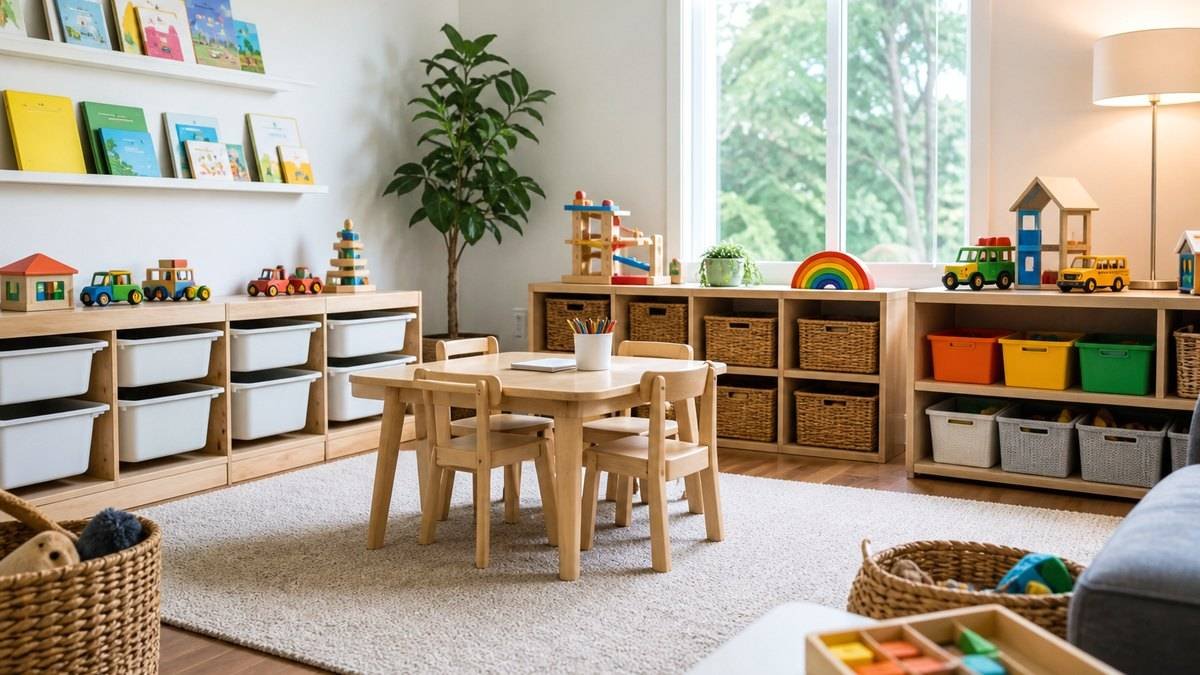
A playroom organizes into zones, and the cleanup routine is what makes them hold. The room that stays tidy is not the one with the most bins; it is the one where each type of play has a home and the cleanup takes five minutes to reset each evening.
Playroom organization ikea setups work when the pieces are mapped to zones instead of bought by the cart, and the same order applies to every brand: decide the zones, match the storage to each zone, and build the cleanup routine before the room is ever used.
Most of the storage below is under $200 total, and the whole room comes together over a weekend.
The Zone System: Play by Type, Store by Type
A playroom divides into five zones, building, vehicles, art, dress-up, and soft toys, plus a bookshelf, and each zone gets one storage home at child height. The zones are the skeleton of the room, because a child cleans up by type of play, which is how they already think about the toys.
Set the zones where the play happens, not where the wall is empty. Building happens on a table or a mat, so the building zone’s bins sit under that surface; art happens at a table, so the art supplies live in a caddy that moves to the table; dress-up happens near a mirror, so the costume rack stands there. A zone two steps from its play spot is a zone that stops being used.
Each zone needs one container, and the container needs a rule: open-front bins for the toys that change daily, closed boxes for the sets that stay assembled, and picture labels on everything so a pre-reader can return a toy without help. The full zone system behind this layout is covered in the toy storage ideas guide on this site, and the playroom version is the same logic in a dedicated room.
Start with three zones, building, art, and soft toys, and add the others as the room proves it can hold them. A playroom with three working zones beats one with eight abandoned ones.
Three zones to start.
The IKEA Playroom Map: Which Piece Goes in Which Zone
The IKEA pieces that show up in every playroom map to zones cleanly: TROFAST for building, KALLAX for books and bins, RÅSKOG for art, FLISAT for the table and dollhouse, DUKTIG for the kitchen, and SMÅSTAD for dress-up and clothes. Each piece earns its place by owning one zone, turning a shopping list into a room.
| Zone | IKEA piece | Rough price | Why it fits |
|---|---|---|---|
| Building | TROFAST frame + boxes | $50-$150 | Open-front boxes at child height, one per category |
| Books & games | KALLAX shelving | $40-$100 | Cubes hold bins or books, display at child height |
| Art | RÅSKOG trolley | $20-$40 | Rolls to the table, holds supplies in three trays |
| Kitchen play | DUKTIG play kitchen | $60-$120 | Defines the kitchen zone with its own footprint |
| Dress-up | SMÅSTAD bench or wardrobe | $100-$250 | Bench stores costumes and doubles as seating |
| Small pieces | GLIS boxes, STÖDJA trays | $10-$30 | Partition the small items inside larger bins |
The playroom organization ikea pieces that earn their place are the modular ones, TROFAST and KALLAX, because they reconfigure as the toys change. The pieces that hold one job, the DUKTIG kitchen and the FLISAT table, stay where the zone is. Read the table as a zone map, not a shopping list, and skip any row whose zone the room does not actually use.
The KALLAX hack that organizes a playroom is the insert: the cube shelves take drop-in drawers, bins, and basket inserts, so the same frame holds toys in one cube and art supplies in the next. The inserts cost $5 to $20 each and are what make KALLAX the most reconfigurable piece in the room, because a cube that holds a bin today can hold a game shelf next year.
Make Every Bin Visible at Child Height
Every bin in a playroom works only if the child can see into it and reach it, so the rule is open-front bins, picture labels, and a child-height shelf line. A bin that a three-year-old cannot open or reach is adult storage wearing a toy bin’s clothes, and the toys will live on the floor instead.
The visibility rule has three parts. Bins are open at the front or clear, so the contents show without opening anything. Labels are pictures, a photo or a drawn icon of the actual toys, not words, so a pre-reader can match the toy to its home. And the shelf line sits low, with the daily zones at the child’s chest height and the adult storage above, because a bin at adult height is a bin the child cannot use.
The rule fails quietly. A beautiful bin with a lid looks organized in the photo and becomes a dumping ground in week two, because opening the lid is the extra step the child skips. The same bin without the lid, or with a clear front, gets used. Buy for the child’s reach, not for the adult’s eye.
The labels take ten minutes and make a good project for the child: photograph the contents of each bin, print the photo, and tape it to the front at the child’s eye level. A three-year-old matches a photo to a bin before they can match a word, and a label the child helped make is a label the child will follow.
Layout the Room: Zones Need Floors and Walls
The room layout follows the zones: activity surfaces in the middle, storage along the walls, and a clear path between them, so the room works without becoming a maze. A playroom with furniture pushed against every wall leaves the floor for the toys, which is the mess the zones are meant to prevent.
Activity surfaces come first. A low table for art and building, a play mat or rug for the soft-toy and vehicle zones, and a reading corner with the bookshelf define where each type of play happens. The surfaces are the anchors the zones attach to, and they double as the cleanup targets: art ends at the table, building ends on the mat.
Storage follows the surfaces. The TROFAST frame sits under or beside the building surface, the KALLAX holds the bookshelf zone, and the RÅSKOG trolley lives at the art table. The path between the door and the play surfaces stays clear, because a blocked path is how toys migrate out of the room and into the hallway.
The layout test is the same one the whole room runs on: if a toy is easier to drop than to return, the layout is wrong. Storage within arm’s reach of its play surface passes the test; storage across the room fails it, no matter how good the bins are.
The reading corner is the zone that needs the most deliberate placement, because books get left wherever they were read. A low bookshelf with the covers facing out, a floor cushion, and a basket for the library haul define the corner, and the cover-facing shelf is the one detail that keeps books on the shelf, because a child picks a book by its cover and returns it the same way.
The Cleanup Routine That Works
The cleanup routine is a five-minute zone-by-zone sweep at a set time each day, and it works because it is short, daily, and tied to an existing habit. A playroom that is cleaned zone by zone in five minutes stays clean; a playroom that waits for a weekly cleanup is a playroom that lives in a mess six days a week.
The routine has three parts. Pick a time that already exists, right before dinner or right before bed, and put the cleanup into that slot. Run the sweep zone by zone, building first, then art, then soft toys, so the child finishes one home before starting the next, and use a timer or a song to make the five minutes visible. End with the “last zone” rule: whatever is left on the floor when the timer ends belongs to the zone it was played in, and the child puts that one zone away fully before anything else.
The routine fails when it becomes a chore with no end, which is why the five-minute cap matters more than the method. A child who cleans for five minutes daily learns the rhythm; a child who cleans for an hour on Sunday learns to dread it. The zones make the five minutes possible, which is why the layout comes before the routine in this order. The routine dies the same way in every home, the timer gets skipped, the zones get skipped with it, and the five-minute sweep becomes an hour-long event on Sunday, so tie the cleanup to a habit that already exists, dinner prep or bath time, and the timer does not have to be remembered, only followed. Every playroom organization ikea setup worth keeping pairs the zones with a cleanup habit, because bins without a routine are a room that resets itself on Sunday.
Rotation Keeps the Room Playable
Rotation keeps a playroom playable by trading the stored toys into the zones every season, so the room never holds more than the zones can absorb. The rotation is the maintenance step that keeps the zones from overflowing, and it takes one box swap per season.
Box the toys the child has not touched in a month and move them to storage, the garage shelf or the top of a closet. Every season, swap one stored box into the zones and move one active category out, and a toy that returns after six months feels new, which is the cheapest refresh a playroom can get. A toy that comes back and still goes untouched for a season moves to the donation pile.
The rotation is also the moment the zones get re-checked. A zone the child has outgrown, the building zone in a house of older kids, gets its storage reassigned, and the room follows the child instead of the original plan. The playroom that adapts is the playroom that stays in use.
The rotation box lives where the zones cannot reach it: the garage shelf or the top of a hallway closet, labeled with the season. A box that is easy to reach becomes a second storage zone, and a second storage zone is how the playroom quietly doubles its toy count.
Anchor Everything: The Safety Pass
The safety pass has three steps: anchor every tall unit to the wall, keep cords and blind strings out of reach, and round or pad the sharp corners. IKEA’s children’s-storage pages end with the same instruction, to anchor furniture to the wall, because a tall unit a child can climb is a tip-over risk no matter how stable it feels.
Anchoring is the non-negotiable step. TROFAST frames, KALLAX units, and SMÅSTAD wardrobes all need anchoring to a wall stud, and the anchor kits cost a few dollars and take ten minutes per unit. The weight that makes a unit feel stable is the weight that makes it dangerous when a child climbs, so anchor everything taller than the child, including the units that seem too heavy to move.
The second pass catches the smaller hazards: curtain and blind cords get tied up or replaced with cordless versions, the outlet covers go on, and the toy bins with lids get a lid that cannot slam. The third pass is the corner check, which matters most around the low table and the KALLAX, where a running child’s head meets the edge. For the room that opens onto the mudroom or the garage entry, the mudroom organization ideas on this site handle the outdoor half of the flow, so the playroom and the entry both stay safe and sorted.
Five zones, one IKEA map, and a five-minute cleanup is the whole system, and it costs about $200 in storage if the room starts empty. The playroom that works is the one where the child can find the toy, play with it, and return it without help, and that is a room worth building once and adjusting every season. The adjustment is the part families skip, and it is the difference between a playroom that works and one that outgrew its plan.