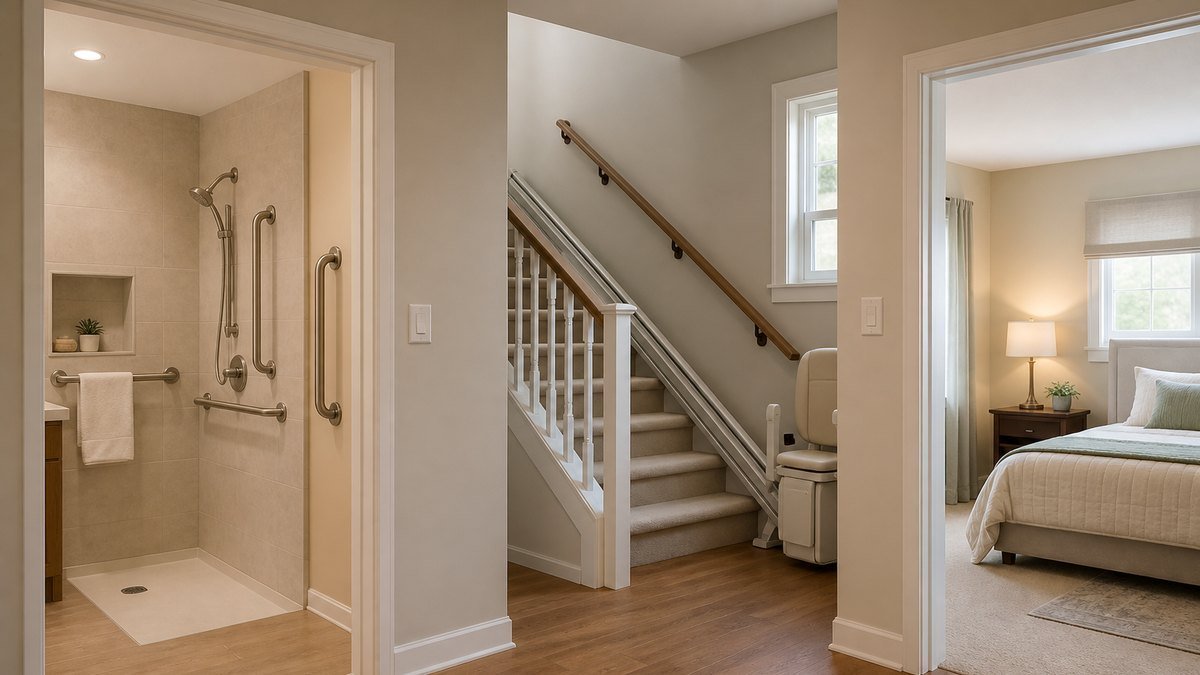
A straight stair lift costs $2,900-$5,000 installed, and curved models run $10,000 to $15,000 or more. Outdoor units land between them, used lifts start around $1,479, and financing at double-digit APRs can add thousands in interest. The cheapest option is often not a lift at all.
Most stair lift pricing pages are published by the companies selling stair lifts, and the numbers vary by thousands depending on whether installation, the battery, and the custom rail are included. The unit price and the installed price differ enough to change the decision.
One line item never appears on the quote: the battery. Every stair lift runs on batteries that wear out every 3-5 years, and replacement is a cost you meet around year four.
What a stair lift actually costs
Stair lift prices split into four families, and the staircase decides which one applies. A straight staircase takes the cheapest equipment; a curved or spiral staircase requires a custom rail, which roughly triples the price.
| Type | Unit price (DIY install) | Professionally installed | What changes the price |
|---|---|---|---|
| Straight stair lift | from $1,499 | $2,900-$8,000, most $2,900-$5,000 | Stair length, seat width, powered swivel |
| Curved stair lift | from $7,599 | $10,000-$15,000+ | Custom rail built to the staircase |
| Outdoor stair lift | from $2,999 | $7,500-$10,500 | Weatherproofing and a protective cover |
| Used or reconditioned | from $1,479 | $2,900-$4,500+ | Battery age, warranty status, model condition |
The figures above come from four sellers’ own published pricing: AmeriGlide and U.S. Medical Supplies quote unit prices, while Lifeway Mobility and Warrior Service quote installed ranges. When a source says “stair lift cost installed,” that is the number that matters, because labor typically adds $500-$1,500 to a straight-unit quote and more for curved work.
Upgrade options add another layer. Folding seats, powered swivels, and remote controls typically run $750-$2,500 on top of the base unit, per Lifeway’s pricing breakdown. Heavy-duty models with higher weight capacity cost more in parts and labor.
What drives the price up
Four factors move the final number, in order of weight: staircase shape, installation labor, weight capacity and features, and whether the unit is new, used, or rented. A straight, unobstructed staircase with a standard weight requirement is the cheapest case.
Curved and spiral staircases are the biggest multiplier. The rail is fabricated to the exact measurements of the stairs, so there is no off-the-shelf part, and that custom work is why curved installations commonly land at $10,000-$15,000. Landings, where the chair must turn, add fabrication and labor on top.
Installation labor is the second-largest line. Most straight units can be self-installed by a capable homeowner in an afternoon, which is how a $1,499 unit becomes roughly a $1,700 total instead of a $3,500 one. Professional installation includes the electrical connection, which in most jurisdictions means a licensed electrician and a local permit; requirements vary by state and city, so the local building department is the authority to ask.
Weight capacity and features follow. Standard lifts carry 264-350 pounds; heavy-duty models go higher and cost more. Swivels, folding tracks, and remote controls add convenience and money, and every unit is battery-powered, which is the quiet cost that shows up at year four.
Who pays: Medicare, Medicaid, the VA, and the IRS
Medicare does not cover stair lifts, and the VA’s home modification grant explicitly excludes them. The realistic funding routes are state Medicaid waivers in some states and the IRS medical-expense deduction, which applies to whatever you pay out of pocket.
Medicare is the fastest dead end to clear. Stair lifts are not durable medical equipment under the program’s definition, and no Part A or Part B benefit covers a permanently installed lift. Anyone planning around “Medicare pays for stair lifts” is planning around a program that does not exist.
The VA route surprises veterans. The Home Improvements and Structural Alterations program pays for medically necessary ramps, bathroom access, and related work, and its exclusion list names “porch lifts, and stair glides” directly. A stair lift is a stair glide, so HISA will not fund it. The VA’s Specially Adapted Housing grants finance whole-home adaptation for qualifying service-connected disabilities, but they are not a per-device fund for a single lift.
Medicaid is the one government route that can pay, and it is state-specific. Home and Community-Based Services waivers in some states cover stair lifts as a home modification when a case manager documents that the lift keeps the person out of institutional care. The question to ask the state Medicaid agency is whether the waiver in your state lists home modifications, and what the per-enrollee cap is.
The most reliable cost offset is the tax deduction. The IRS lets you deduct unreimbursed medical expenses above 7.5% of adjusted gross income, and Publication 502 treats medical home improvements as medical care: the full cost if the improvement adds no home value, and the amount above the added value if it does. A stair lift that serves a medical need fits that rule, though a tax professional should confirm the numbers for your situation.
There is no nationwide “free stairlift” program in the United States. The United Kingdom’s Disabled Facilities Grant, sometimes quoted as an answer to that question, does not exist here; the US equivalents are the state waivers above, local nonprofits, and the deduction.
DIY installation and the used market
“Self-install” on a seller’s page is a real option for a straight stair lift, but it is not free. The trade-off is the warranty, the electrical work, and what happens at resale, and the used market prices in all three.
A straight unit mounts to the stairs with a track, and a handy owner can install it in an afternoon. The electrical hookup is the part most jurisdictions regulate, so the honest DIY plan includes an electrician visit and a permit check. Installing it yourself usually voids nothing, but the warranty fine print is worth reading before you skip professional labor.
Used and reconditioned lifts start around $1,479, which looks like a bargain against a $3,500 install. The catch is the battery. A used unit may be close to its 3-5 year battery replacement, and that replacement is a real cost. Reconditioned units from the manufacturer carry some warranty; private-sale units carry none, and the resale market for stair lifts is thin, so the “investment” framing on seller pages does not survive contact with year five.
Alternatives worth pricing first
Price the zero-dollar option before the lift: move the bedroom and the bathroom essentials downstairs. For a home where that works, the cost is furniture moving, and it retires the staircase problem entirely.
When moving rooms is not possible, compare the lift against the other hardware. A platform lift carries a wheelchair user up the stairs, which a stair lift cannot do. A residential elevator, which dealers typically quote at $20,000-$50,000 or more, serves the whole house and wheelchair users, at a very different price. For the narrow case of a person who can walk but cannot climb, a stair lift remains the low-cost option among the hardware.
The decision framework: measure the staircase, test whether the user can transfer onto a lift seat, get three installed quotes that itemize labor and the battery, and check the state waiver and the IRS deduction before signing financing. For a home where a first-floor bedroom and bath are achievable, the aging-in-place home modifications walkthrough maps that reconfiguration room by room, and the universal design at home examples show the wider approach for homes where accessibility is a long-term goal rather than a response to an injury.
Common questions, straight answers
Is a stair lift covered by Medicare?
No. Medicare Part A and Part B do not cover stair lifts, because a permanently installed lift is not durable medical equipment under the program’s definition. State Medicaid waivers may pay in some states, and the IRS medical-expense deduction can offset your out-of-pocket cost, but Medicare will not.
What is the average cost of a stair lift?
A straight stair lift installed runs about $2,900-$5,000, which is the average case. Curved models cost $10,000-$15,000 or more because the rail is custom-built, outdoor units run $7,500-$10,500 installed, and used lifts start around $1,479 plus installation.
Who qualifies for a free stairlift?
No nationwide free stairlift program exists in the United States. The UK’s Disabled Facilities Grant, a program sometimes quoted in this context, does not apply here. The closest US routes are state Medicaid home and community-based services waivers, which cover stair lifts in some states, and local nonprofits; both require an eligibility review.
What are the disadvantages of a stair lift?
Stair lifts need a clear, unobstructed staircase, so they block the stairs while parked. They do not carry wheelchairs or walkers, the resale market is thin, and the battery needs replacement every 3-5 years. For wheelchair users or homes where the stairs cannot be cleared, a platform lift or a first-floor reconfiguration beats a stair lift.