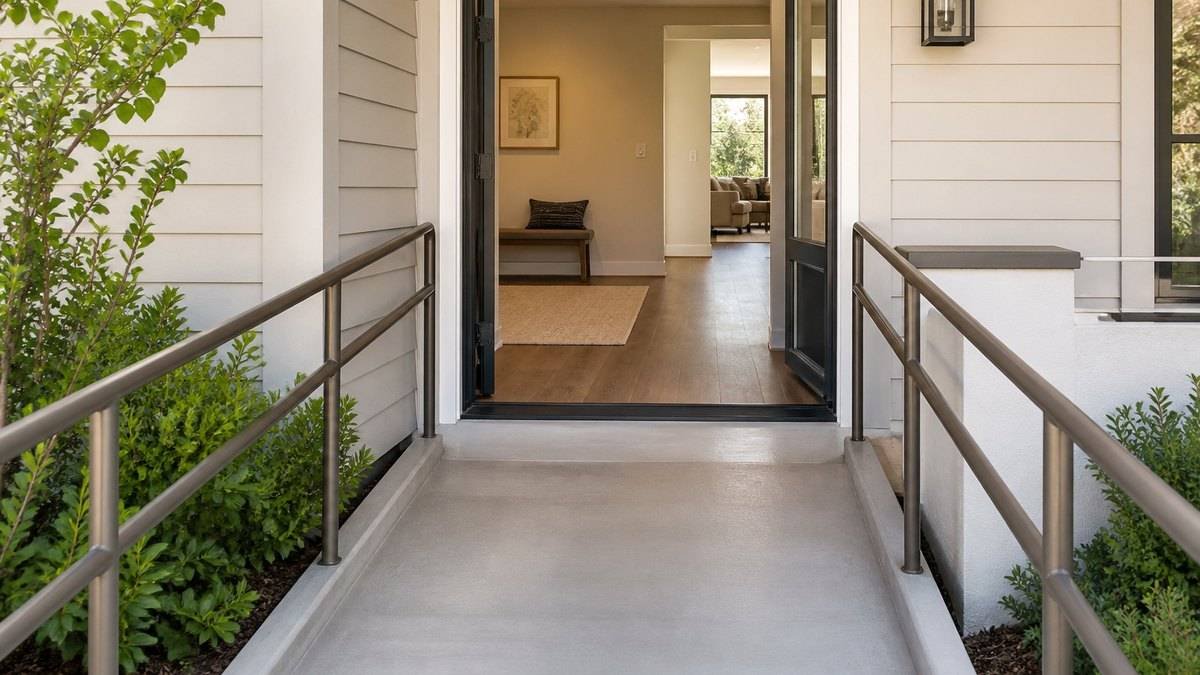
The cost to install wheelchair ramp is driven by one number first: the rise. The 1:12 slope rule means every inch of height needs 12 inches of ramp, so a 24-inch entry needs a 24-foot ramp, and the length decides the material cost, the labor, and whether the project needs a permit.
A standard residential ramp installation runs between $1,000 and $10,000, per Mr. Handyman’s cost guide, with wooden ramps at $1,000 to $2,500, aluminum at $2,000 to $5,000, and concrete at $3,000 to $10,000. Contractors often quote $100 to $250 per linear foot including materials and labor, which turns the rise measurement into a rough price before any quote.
The cost to build a wheelchair ramp, whether wood, aluminum, or concrete, follows the same five factors: length, material, footings, handrails and landings, and the local labor rate. The sections below run the arithmetic, the material ladder, the cost factors, and the planning and funding.
The 1:12 rule: rise decides length, length decides cost
The ADA slope standard for a ramp is 1:12, one inch of rise for every 12 inches of run. Measure the height from the ground to the entry threshold, multiply by 12, and the result is the minimum ramp length: a 12-inch step needs a 12-foot ramp, a 24-inch entry needs 24 feet, and a 36-inch porch needs a 36-foot ramp with landings.
The shortcut contractors use is that the rise in inches is roughly the ramp length in feet. A 20-inch rise is about a 20-foot ramp, and the quote follows: at $100 to $250 per linear foot, a 20-foot ramp lands between $2,000 and $5,000 before the extras.
The rise measurement is also what the per-foot cost guides build on, which is why the first step of any ramp project is the tape measure on the step, not the phone call to a contractor. A family that measures the rise before calling gets a usable quote; a family that does not gets a site visit fee and a guess.
The material ladder: portable, aluminum, wood, and concrete
Ramp costs follow a four-step ladder by permanence. Portable and threshold ramps, for a single step or a low lip, run about $65 to $500 and install in minutes. Modular aluminum ramps, for a permanent mid-range install, run about $3,000 to $6,000 for a typical entry and bolt together without a concrete pour. Wooden ramps run $1,000 to $2,500 built on site, and concrete ramps run $3,000 to $10,000 as the most permanent option.
The material trade-offs go beyond price. Aluminum lasts decades, needs no painting, and survives weather, which makes it the value pick for permanent ramps. Wood is the cheapest built option but needs yearly maintenance, sealing, and inspection. Concrete is the most durable and the most expensive, and it requires the footing and permit work of a full construction project.
The ladder matches the use: a rental or a one-step fix points to portable or modular, an owned home with a standard entry points to aluminum or wood, and a home where the ramp is permanent, long, or part of a larger renovation points to concrete.
What drives the cost: footings, handrails, landings, and labor
The base length and material are half the cost; the rest comes from four factors: footings and site work, handrails, landings, and the local labor rate.
Footings and site work add $500 to $2,000 when the ground needs leveling, gravel, or a concrete pad under the ramp’s posts. Handrails, required on most ramps and always worth having, add $15 to $30 per linear foot. Landings, the level platforms at the top, bottom, and every 30 feet of length, add square footage that is not ramp but must be built. And the local labor rate moves everything, which is why the same ramp costs more in a metro area than a rural one.
The labor cost guides break the same factors into per-hour and per-foot components, and a family building their own estimate should add 20 to 30 percent over the material quote for the footings, landings, and handrails that every real install includes.
Permit fees belong in the same list. The cost guides note that permits run $50 to $500 depending on the locality, and the permit question is answered by the local building department, not the contractor.
Buy or build: portable, modular, or on-site
The buy-versus-build decision is the material ladder in practice.
Buying wins for a portable or modular ramp: a factory-made aluminum ramp arrives complete, bolts together, and can be moved if the household relocates. Building wins when the ramp must fit an irregular entry, reach a long rise, or match a permanent concrete structure. The DIY line sits between the two: a portable ramp is a purchase, a modular ramp is a weekend install, a wood ramp is a real construction project, and a concrete ramp is a job for a licensed crew with a permit.
Retailers like Lowe’s and Home Depot do not install ramps with their own crews; they connect homeowners to licensed third-party installers, so the “who installs it” question resolves to the same local licensed contractor either way.
Permits and building codes: what to check before the quote
The permit question has two parts, per the local-authority guidance. A ramp placed on a public sidewalk or right-of-way needs approval from the local authorities, and a ramp that is part of a larger renovation may need a building permit. The code guides add the construction requirements: the 1:12 slope, the 36-inch width, the handrails on ramps above a certain rise, and the landings that the local code adopts.
Call the local building department before the quote, not after, because the department answers three questions the contractor cannot: whether the ramp needs a permit, whether a right-of-way approval applies, and which code version governs the slope and handrails. The answers add cost and timeline, and they belong in the budget.
The permit and code check is also the insurance check: a ramp built to the local code is a ramp an insurer and an inspector accept, and the aging-in-place home modifications guide covers how the ramp fits the staged accessibility plan.
Funding the ramp: Medicare, Medicaid, VA, and the assistance map
The funding question resolves differently for each route. Medicare does not cover a ramp, because it is a home modification rather than durable medical equipment. Medicaid home and community-based services cover ramps as modifications in many states, with a case manager as the gate. Veterans use the VA’s HISA benefit for medically necessary ramps and the SAH and SHA grants for qualifying service-connected disabilities. And the USDA Section 504 program covers ramps for very-low-income rural owners.
The grants for home modifications for disabled guide covers the full funding list, and the eligibility test is the same as every accessibility route: disability-triggered work starts with the Medicaid case manager or the VA regional office, and income-triggered work starts with the county office. A ramp is one of the most commonly funded modifications, because it is the modification that keeps a home reachable at all.
The planning order closes the loop: measure the rise, pick the material ladder, add the footings and handrails, check the permit, and route the funding before the quote becomes a contract.
Frequently asked questions
Will Medicare pay for a ramp for seniors?
Medicare generally does not cover a wheelchair ramp, because it treats ramps as home modifications rather than durable medical equipment. The coverage lives elsewhere: Medicaid home and community-based services in many states, the VA’s HISA benefit for medically necessary ramps and the SAH and SHA grants for qualifying veterans, and the USDA Section 504 program for very-low-income rural owners.
Is it cheaper to buy a wheelchair ramp or build one?
Buying is cheaper for portable and modular ramps: a factory-made aluminum ramp runs about $3,000 to $6,000 for a typical entry and installs without a concrete pour. Building is cheaper for wood on site at $1,000 to $2,500, but adds yearly maintenance. Concrete at $3,000 to $10,000 is the most expensive and the most permanent, and it is a professional job either way.
Does Lowe’s install handicap ramps?
Lowe’s and Home Depot do not install ramps with their own crews; they connect homeowners to licensed, insured third-party installers who schedule and complete the work. The quote comes from the local installer, and the permit and code questions go to the local building department rather than the retailer.
Do I need a permit to install a wheelchair ramp?
Often yes. A ramp placed on a public sidewalk or right-of-way needs approval from local authorities, and a ramp that is part of a larger renovation may need a building permit. Call the local building department before the quote to confirm whether a permit applies and which code version governs the slope, width, and handrails.
How much does a wheelchair ramp cost per square foot?
Contractors typically quote $100 to $250 per linear foot including materials and labor for a built ramp, with the total for a standard residential install between $1,000 and $10,000 depending on length and material. Wood runs $1,000 to $2,500, aluminum $2,000 to $5,000, and concrete $3,000 to $10,000, before the footings, handrails, landings, and permits add 20 to 30 percent.