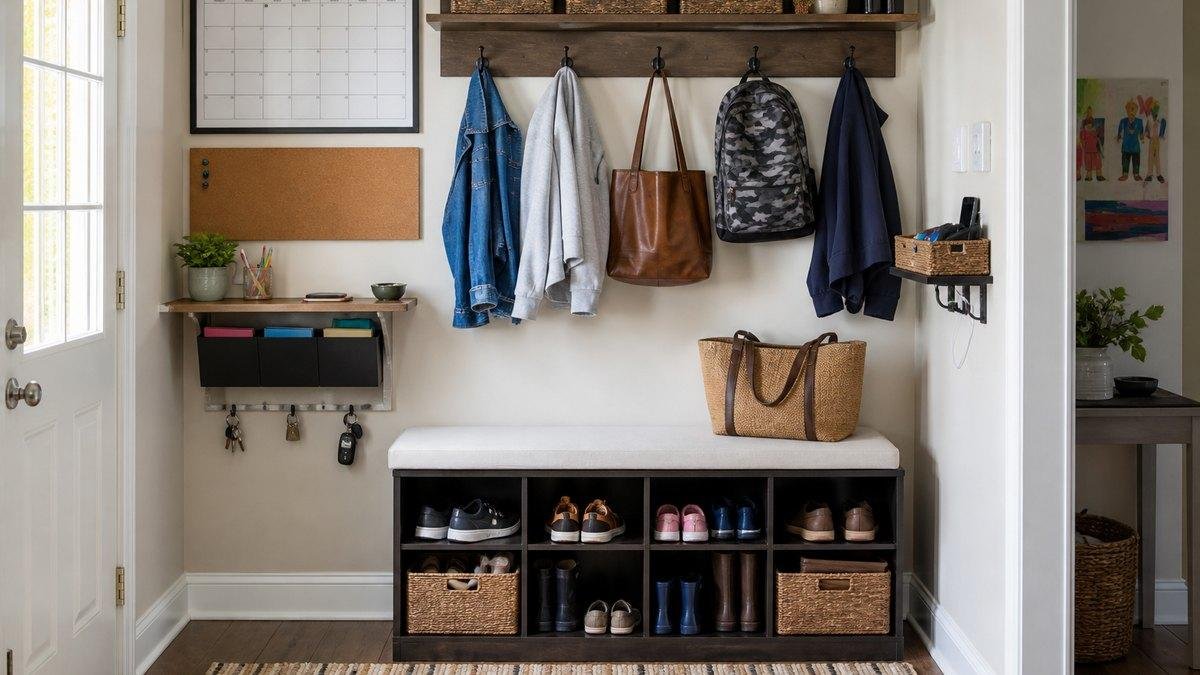
A mudroom organizes outerwear, footwear, and family gear into one system at the door you actually use. It is the sixty-second zone: everything comes off in sixty seconds coming in, and everything is found in sixty seconds going out.
Mudroom organization ikea setups work when the pieces are mapped to the three zones instead of bought one by one, and the same order applies to every brand: hooks for the coats, a rack for the shoes, and a cabinet or locker for the gear. Small spaces get the same three zones in a vertical stack.
Everything below is under $300 unless you are building cabinets, and the room comes together over a weekend.
Outerwear, Footwear, and Gear: The Three Zones
A mudroom divides into three zones, outerwear on hooks, footwear on a rack or tray, and family gear in a cabinet or locker, and each zone gets one rule that makes it self-maintaining. The zones are the skeleton of the room, because they match the order a person undresses at the door.
The outerwear zone comes off first and goes on hooks, one hook per person at the height of the person who uses it. Hooks beat hangers in a mudroom for the same reason they win in an entryway: a hook takes one hand, and the hand that is free is already holding the door. The coats in rotation, the jacket, the raincoat, the one for the cold snap, number four or five per person, and the rest lives in the closet.
The footwear zone is the pile problem. Shoes and boots need a boundary, a rack, a bench with a shelf, or a tray that catches the mud, within arm’s reach of the door. A boot tray under the rack catches the wet and keeps the floor clean, and a floor without a shoe pile is the fastest visible win in the whole room.
The gear zone is the one that disappears without a system. Sports bags, backpacks, helmets, and the dog’s supplies each need a spot, a locker, a cabinet shelf, or a labeled basket, because gear without a home migrates to the floor and the bench, and the bench becomes the pile.
Hooks, rack, cabinet.
The Mudroom Closet: Outerwear Storage That Works
The mudroom closet organizes outerwear in four layers: the top shelf for out-of-season gear, a double rod for the current coats, the door for accessories, and the floor for the boots. The same four-layer layout works whether the closet is a full walk-in or a narrow nook, and it keeps the daily hooks clear for the coats actually in rotation.
The top shelf holds the out-of-season items, the winter coats in June, the rain gear in January, in labeled bins so the stack stays honest. The hanging space doubles with a second rod at half height for the shorter jackets and the children’s coats, and the door gets an over-door organizer for scarves, gloves, and hats. The floor holds a boot tray or a shoe rack, never loose boots in a pile.
The closet and the mudroom split the workload: the daily hooks hold the four or five coats per person in rotation, and the closet holds the rest. A mudroom with twelve coats on the hooks is a mudroom where nobody finds their jacket, and the closet is what prevents that. The same four-layer logic applies in a bedroom closet, and the small bedroom closet organization ideas on this site walk through the layouts for a 36-inch rod.
Small Mudroom and Home Organization Ideas for Small Spaces
Small mudroom organization ideas follow one rule: go up before you go out. A narrow wall takes a vertical run of hooks, a slim shoe cabinet takes the floor footprint of a shoebox, and the back of the door takes the accessories, so a small space gets all three zones without losing the walkway.
The vertical hook run is the small-space workhorse. Three to five sturdy hooks in a staggered vertical line hold the daily coats and bags on a wall that is too narrow for a bench, with the children’s hooks at the bottom and the adult hooks above. A mirror above the hooks gives the wall a purpose and makes the space feel larger.
A slim shoe cabinet, the IKEA TRONES style at about 7 inches deep, holds a full family’s shoes in the footprint of one pair, and it doubles as a shelf for keys and the daily carry. The back of the door adds an over-door organizer for the gloves, hats, and small gear, and a fold-down bench or a sturdy stool provides the seating without claiming permanent floor space.
The home organization ideas for small spaces apply the same vertical logic to every room: shelves above the furniture, hooks on the doors, and bins under the benches. A small mudroom is not a smaller version of a big one; it is a vertical version, and the three zones stack instead of spread.
Two more small-space spots exist in most homes: under the stairs and the end of a hallway. A stair landing or the space under a staircase holds a bench with storage or a vertical run of hooks, and a hallway end with a mirror and two hooks creates a mini mudroom where no room exists. The home organization for small spaces trick is to treat these dead ends as vertical storage, because a hook wall in a hallway costs the same as a hook wall in a mudroom and works the same way.
The IKEA Mudroom Map: Pieces That Earn Their Spot
The IKEA pieces that carry a mudroom map to the three zones: HÖVOLM and the hook rails for outerwear, NIPÅSEN and HEMNES for footwear and seating, TRONES for the slim shoe cabinet, and BESTA or HALLAN for the gear lockers. Each piece earns its place by owning one zone, and the mapping turns a shopping trip into a room.
| Zone | IKEA piece | Rough price | Why it fits |
|---|---|---|---|
| Outerwear | HÖVOLM hook rack (6 knobs) | $23 | Six hooks, one wall, holds the daily coats |
| Outerwear | MULIG clothes rack | $10 | Portable overflow rail for the off-season or guests |
| Footwear | NIPÅSEN coat rack + bench with shoe storage | $100 | Bench, hooks, and shoe storage in one footprint |
| Footwear | TRONES shoe/storage cabinet | $40-$60 | 7-inch-deep cabinet, a full family’s shoes |
| Footwear | BAGGMUCK shoe tray | $15 | Catches mud and wet under the rack |
| Gear | BESTA or HALLAN cabinet | $100-$300 | Lockers or drawers for bags, helmets, and supplies |
The mudroom organization ikea pieces that earn their spot are the ones that own a zone completely. The NIPÅSEN bench-and-hooks unit is the highest-value single piece, because it covers outerwear and footwear in one footprint, and the BESTA or HALLAN locker system is the upgrade that adds the gear zone. Read the table as a zone map, and skip any row whose zone the mudroom does not need.
The NIPÅSEN is the piece that surprises people: at about $100 it covers the bench, the hooks, and the shoe storage in one unit, which is the three-zone system in a single footprint. The locker-style BESTA or HALLAN upgrade adds a door per person, which is the difference between a gear shelf and a gear system, because a closed locker with a name on it stays organized the way an open shelf never does.
Family Gear: Sports Bags, Backpacks, and the Dog’s Stuff
Family gear organizes into two groups, one spot per person for the bags, and one cabinet or basket for the shared supplies, the sports gear, the helmets, and the dog’s things. The gear zone is the difference between a mudroom and a pile, and it works when every item has a labeled home.
The per-person bag spot is the first rule. Each family member gets one hook or one locker shelf for the backpack or sports bag, at their height, and the bag lives there the moment it comes in the door. A bag without a spot is a bag on the bench, and a bench covered in bags is the gear zone’s failure mode.
The shared supplies get a cabinet or a labeled basket: the dog’s leash and food, the soccer ball and pump, the helmets, the spare mittens. One cabinet with a shelf per category beats a pile on the floor, and the labels are what keep the categories from merging back into a pile by spring.
The gear rule is one-in-one-out, the same as the shoe rule. When a new bag or a new pair of cleats arrives, an old one leaves, because a gear zone with no exit fills up and the pile returns. The toy storage ideas on this site apply the same one-home logic to the toys that pass through the mudroom on their way to the playroom.
The Daily Mudroom Routine
The daily mudroom routine is a sixty-second pass at the door, coats to hooks, shoes to the rack, bags to their spots, and a weekly ten-minute reset for the tray and the cabinet. The routine is what keeps the three zones working, because the zones hold the system and the routine holds the zones.
The sixty-second pass happens every time someone comes in, and it takes less time than the pile takes to build. Coats come off onto the hooks, shoes come off onto the rack or the tray, and bags go to their spots before anything else, because the pile starts the moment the first item is dropped instead of placed.
The weekly reset is ten minutes: the shoe tray gets washed, the floor gets swept, the cabinet shelves get straightened, and the out-of-season coats move to the closet. Pick a slot that already exists, Sunday afternoon or laundry day, and the reset keeps the room from decaying into the pile it replaced. The mudroom organization ikea pieces and the routine are two halves of one system, and the room fails when either half is missing.
Anchor the Hooks: What the Hacks Don’t Tell You
The mudroom’s most common failure is the hook that pulls out of the wall, because a hook loaded with coats and bags carries more weight than the drywall can hold. Anchor every hook rail and cabinet to a wall stud or use heavy-duty anchors rated for the load, and the room survives the first winter instead of the first week.
The real-world warning is specific: one blogger’s mudroom rebuild started because her hooks ripped out of the wall, wrecking the wallpaper, even though they were installed with wall anchors. A hook rail for coats and bags can carry 20 to 40 pounds per hook once it is loaded, and a standard drywall anchor fails well below that. The fix is a stud-mounted rail, or heavy-duty toggle anchors, and it costs the same as the weak alternative.
The anchoring pass covers the whole room: the hook rails, the tall cabinets, the bench with storage. Anchor anything taller than a child and anything that holds weight at the door, and check the anchors twice a year, because a mudroom that survives the school year is the one whose hooks stayed in the wall. The anchoring hardware matters as much as the act. A stud-mounted rail or toggle anchors rated for 50 pounds or more hold the loaded hooks; plastic drywall anchors and adhesive strips do not, no matter what the package claims. The extra cost is a few dollars per hook, and the alternative is a hook that lands on the floor with the coats still on it.
Three zones, one IKEA map, and a sixty-second routine is the whole system, and it costs about $150 with a NIPÅSEN bench and a TRONES cabinet. The mudroom that works is the one where the coats land on hooks that stay in the wall, the shoes land on a tray that catches the mud, and the bags land in spots that hold them, and that is a room worth building once and resetting every week. The same cabinet logic carries through the rest of the house, and the linen closet organization ideas on this site apply it to the linens and towels that share the same storage principles, zone by zone through every room.