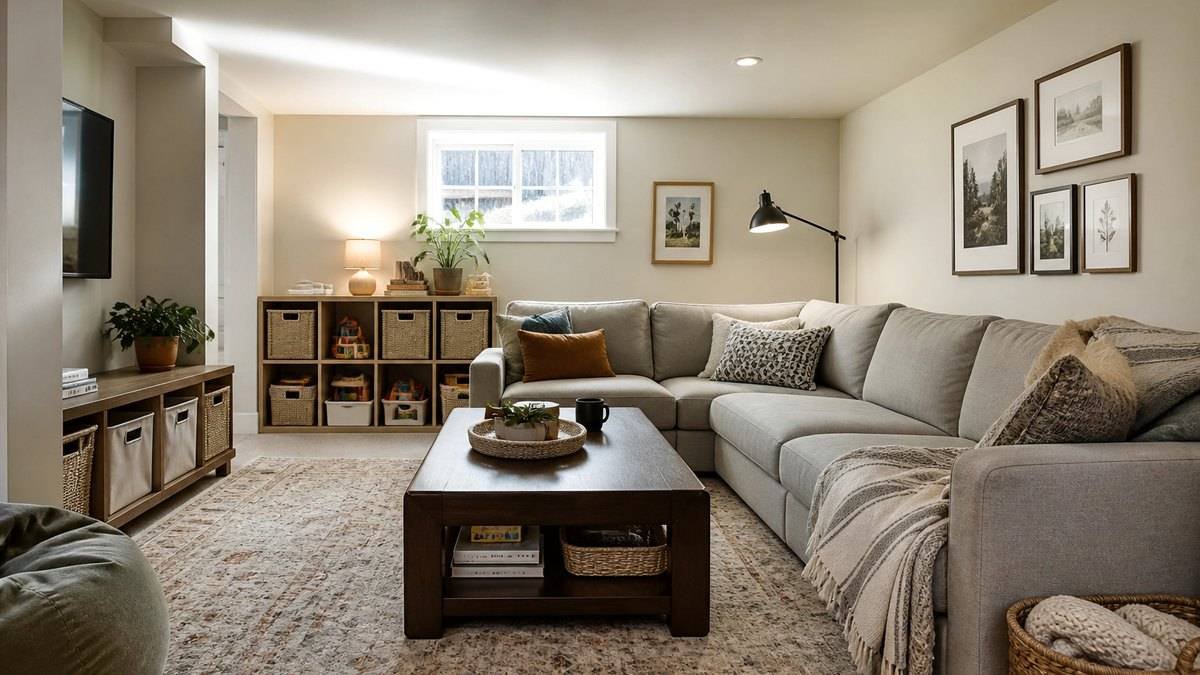
Family room wall decor should survive the family. Choose pieces that handle damp hands, marker caps, and the occasional throw pillow, then build the wall around the photos people actually care about. Everything else is decoration you can swap later.
The family room is the room where the couch has a blanket on it and somebody is always doing homework at the coffee table. It is also the room where walls get touched. A gallery of thin glass frames at shoulder height looks lovely in a catalog photo and takes damage in about a month of real life.
Ours went through the phase of too many frames. Nine small prints, three sizes, none of them level for long. It took one Saturday and a box of hooks to realize the failure was the plan, not the hanging.
Why a Family Room Needs Different Wall Decor
A family room’s walls need decor that tolerates daily use: washable or damage-resistant materials, art hung out of reach or mounted to survive bumps, and a plan that leaves room for everyone’s taste. Formal living room rules do not apply here.
Usage is what separates them. A living room is staged for guests and kept tidy; a family room is where the household actually lives, which means spills, games, pets, and the occasional object thrown at the television during playoffs. Wall decor that works in one will not automatically work in the other.
Three filters sort most choices. Can it be cleaned? Can it be replaced without redoing the whole wall? And can two people with different taste agree on it? A piece that fails any of the three belongs in a room nobody touches.
Taste coordination works better than consensus. Give each person one small element they chose themselves, on a shelf or a ledge, and keep the main wall to a single decision. The wall stays coherent because one person owns the big call and everyone else owns a small one.
Room size changes the answer too. A compact family room needs the same space-efficiency thinking as any small shared room, which is covered in our small living room decor ideas that maximize space; the wall rules above apply on top of that.
None of this means the walls should look utilitarian. It means the pretty choices come after the practical ones, and the practical ones are chosen to last.
Build a Family Photo Wall That Ages Well
Pick a small number of photos, put them on canvas or in matching frames, and lay them out as one measured grid so the wall still looks right in five years. Update the arrangement twice a year instead of every week.
The family photo wall is the one wall treatment that belongs in a family room by definition, and it is the easiest way to make the space feel personal without buying anything new. The mistake is treating it as a place to park every photo you have ever taken.
Three rules keep it under control. Limit the count: twelve pieces reads as a curated wall, forty reads as a closet. Pick a consistent finish, all black frames or all natural wood, so the photos carry the color. And choose the strongest shot from each occasion rather than three similar ones from the same trip.
Choosing which photos is the part people skip. Work backward from the wall: pick the twelve strongest moments, one per occasion, and delete the near-duplicates first. If a photo would only matter to the person who took it, it stays in the album rather than on the wall. Black-and-white versions of old prints unify mismatched originals.
Material decides how long the wall lasts. Canvas prints are the forgiving option: no glass to break, easy to wipe, light to hang. Framed prints look sharper but belong above the sofa line or in a spot nothing gets thrown near. If you want to rotate often, a picture ledge or a magnetic system beats re-hanging frames each time.
The upgrade path matters too. Start with inexpensive frames and swap in better ones as the wall proves itself, rather than spending on the first arrangement. A photo wall earns its permanent frames after it has survived a year without being rearranged.
Layout follows one measured grid. Lay the pieces on the floor first, arrange them by size with the largest near the center, then measure the whole arrangement as a single rectangle and mark its center at eye level, about 57–60 inches up. Tape paper templates to the wall before the first nail. Odd numbers of pieces read best, which is the same instinct behind the 3-5-7 rule used across interior design.
Start with the tree or start with the photos, but not both on the same wall.
If the family history angle appeals, a family tree wall decor piece works as the anchor: a printed tree with names and years, a wood-carved version, or a canvas with photo frames along the branches. Keep it to one wall and let it be the statement, because a second busy element beside it will split the eye.
Wall Decor Materials That Survive Kids and Pets
Canvas, metal wall art, wood pieces, and washable textiles outlast glass-framed prints in a family room. Keep fragile frames at adult height, and mount everything into studs or use hardware rated for the weight.
A quick material rundown, ordered by how well each handles real use:
- Canvas prints. Light, wipeable, no glass. The default choice for anything at reachable height, and the easiest to swap when a photo stops being the favorite.
- Metal wall art. Nearly indestructible and washable, but heavy. It needs studs or strong drywall anchors, and it stays cool to the touch in winter, which surprises no one until they brush past it.
- Wood signs and carved pieces. Durable, warm, and forgiving of bumps. Avoid sharp corners at toddler height.
- Framed prints with glass. Best looking, worst behaved. Keep them above the line a thrown toy can reach, or skip glass entirely and use acrylic glazing.
- Tapestries and woven wall hangings. Hide wall marks, soften sound, and some are machine washable. They also pad the wall where kids bump into it.
- Magnetic or swap systems. A magnetic rail or framed panel lets the household rotate artwork and schoolwork in seconds. Best value per square foot of wall in a busy room.
Mounting rules apply to all of them. Anything heavier than a few pounds goes into a stud or a rated anchor, and anything at kid height gets the same mounting quality as the piece at eye level, because kids pull on what they can reach.
Maintenance is short. Wipe canvas with a barely damp cloth, dust metal pieces, and vacuum tapestries with a brush attachment twice a year. When a frame’s glass gets scratched, replace the glazing rather than the whole piece.
Practical Wall Features for the Walls Everyone Uses
Magnetic panels, chalkboard or whiteboard walls, picture ledges, and low-wall clear zones turn shared walls into usable surfaces rather than fragile displays. Reserve the bottom stretch of active walls for kid-height function.
A magnetic panel is the quiet workhorse of a family room. Paint one wall section with magnetic primer and a topcoat, and you get a rotating gallery for school artwork, a spot for the week’s calendar, and a place to park the drawings that are too good to throw away. The panel also ends the daily negotiation over which drawing earns the refrigerator door. Everything goes on the wall, nothing sticks to the appliance, and the rotation becomes a two-minute job on Sunday nights. Chalkboard or whiteboard sections do the same job for lists and homework.
Picture ledges earn their place in a family room because they change with the household. A six-foot ledge holds frames, kid art, a small plant, and the seasonal swap without a single new hole in the wall. The standard advice: swap the arrangement twice a year and the ledge always looks current.
The bottom two feet of a wall in an active play area should stay clear or stay washable. A blank strip of wall, a wipeable panel, or a low shelf with a washable cover beats a fragile frame that gets collected by a stray ball. The same reasoning applies to the television wall: keep the screen, one shelf, and one quiet accent, and nothing else on that wall.
Media walls get their own rule. Where the family plays video games or watches movies, keep the wall behind the screen nearly bare, because busy walls behind moving images read as noise. One shelf of controllers and a single accent is enough.
Rental homes change the math. If the lease bans nails and adhesive residue, lean on floor-leaning art, tension rods for lightweight textiles, and picture ledges mounted with damage-free strips rated for the load.
Family Wall Decor That Stays Within Budget
The cheapest family wall decor is a well-laid-out photo wall with frames bought in sets, plus one or two statement pieces saved for. Skip the impulse buys and let the photo wall carry the room.
Frames in matched sets from a store like IKEA cost a fraction of custom framing, and the uniform finish is what makes a budget wall look deliberate. Canvas prints of family photos ordered as a batch come out cheaper per piece than single framed prints, and they match each other by default.
The budget order of operations: build the photo wall first, add one anchor piece with real presence, then wait. Most family rooms do not need a fourth element, and the money saved on the wall usually finds a better home in furniture or lighting. Broader cost-saving moves for the whole room are collected in our home decor ideas on a budget; the wall-specific version is the photo wall plus one anchor.
Thrift stores and the kids’ own work fill in the gaps. A mismatched collection of secondhand frames becomes intentional the moment they are spray-painted one color, and a child’s best painting in a good frame beats a mass-produced print at any price. Etsy sellers do custom family tree pieces in wood and canvas at a range of prices, though the finish varies with the seller, so read reviews before ordering.
The same logic runs through the whole plan: choose what survives contact with the household, then make it look intentional. The photo wall is the piece worth doing properly; everything else on the walls can be replaced in an afternoon.
Frequently Asked Questions
How to decorate a wall in a family room?
Start with a family photo wall, hang it in durable materials, and leave the lower walls clear for daily use. Choose canvas or wood frames over glass, center the arrangement near eye level, and use a picture ledge if you want to rotate artwork often. This formula covers most family room wall decor setups without turning the room into a museum.
What kind of wall art is best for a living room?
One large canvas or a grouped photo wall is best for a living room, hung with the center near eye level. A single oversized piece reads as intentional and needs one nail; a photo wall works when the frames share a finish. In a family room, choose canvas over glass so the art survives daily use.
What is the wall decor for 2026?
In 2026 the trend leans toward natural materials, warm neutral tones, and fewer but larger pieces, with vintage mirrors staying popular. Woven and cane pieces, wood accents, and sculptural objects are replacing dense collections of small prints. For a family room this direction is convenient, since bigger single pieces and textured materials are easier to clean and maintain.
What is the 3-5-7 rule in interior design?
The 3-5-7 rule is a decorating guideline that says odd-numbered groupings look best: three items for most arrangements, five for longer walls, seven for very wide ones. An odd count gives the grouping a center piece, so the eye has a clear place to land. It applies to shelves, mantels, and photo walls alike.