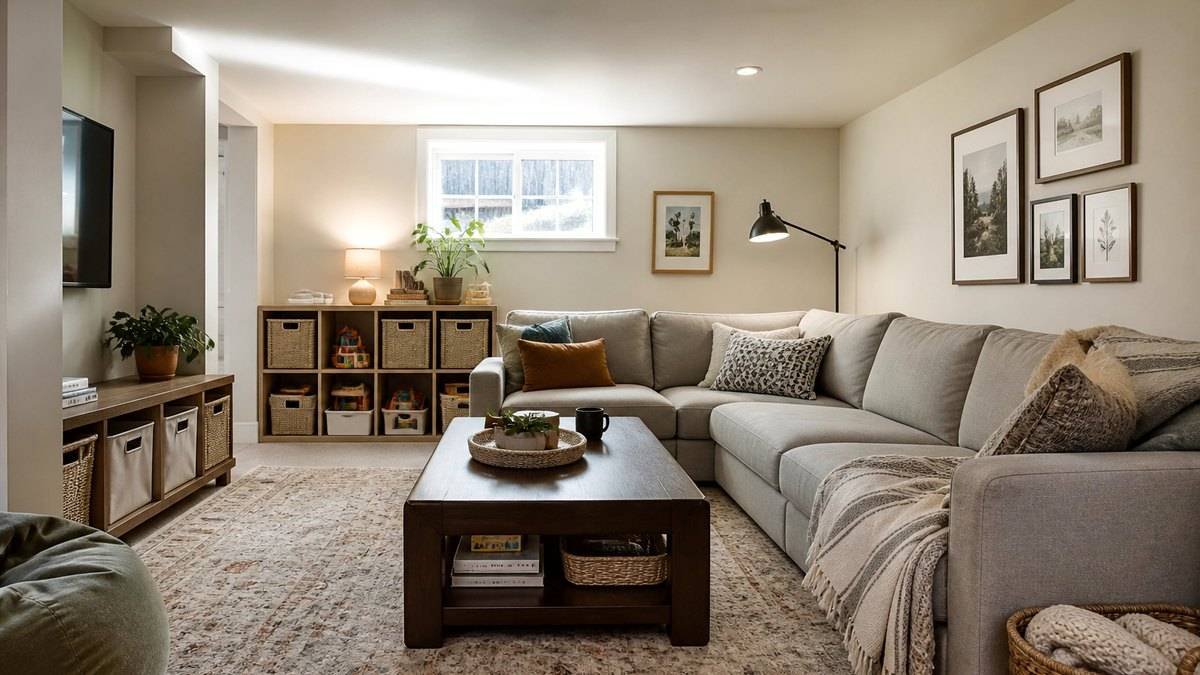
A family room decorates for durability first, comfort second, and style third. The room that gets lived in every day needs materials that survive the living, and the style that lasts is the one built on washable fabric and low-maintenance surfaces.
Family room decor ideas work in the same order every time: choose the durable materials, set up the seating, hide the storage, and add the comfort layers. The order matters because a beautiful family room with a stain-proof sofa outlives a beautiful room with a delicate one, every time.
Most of the changes below cost under $200, and the room turns around over a weekend.
Durable First: The Room That Gets Lived In
Durable family room decor starts with the materials: washable sofa covers, stain-resistant fabric, low-maintenance flooring, and easy-clean surfaces, chosen before the style. The family room is the room that absorbs the snacks, the pets, and the spills, and the materials decide whether it survives them or shows them.
The fabric rule comes first. Performance fabrics, labeled for durability and stain resistance, and machine-washable sofa covers handle the daily life that delicate fabrics cannot, and the family room is the one room where fabric choice matters more than color. A dark or patterned fabric hides the everyday marks better than a light solid, and a washable throw over the sofa back catches the hair and the crumbs.
The surfaces follow the fabric. Low-pile or indoor-outdoor rugs resist the spills and vacuum clean, washable wall paint, a satin or eggshell finish, wipes down without a trace, and the coffee table in wood or laminate survives the board games. The durable-first rule is that every surface answers the clean-up question, and a surface that cannot be cleaned in place is a surface that will show the room’s history.
Durable, comfortable, washable.
Family Room vs. Living Room: What You’re Actually Designing
A family room is the casual everyday room for games, TV, and family time, while a living room leans formal and guest-facing. The Architectural Digest definition puts it plainly: the family room is for sweatpants and sectionals, and the living room is for entertaining, so the family room decorates for the life it hosts.
The family room gets the low-maintenance everything, because it is used daily. The living room can hold the delicate sofa and the light rug, because it is used for occasions; the family room holds the washable sofa and the stain-hiding rug, because it is used for everything else. The same square footage decorated for the wrong room is the mismatch that makes a family room feel fragile or a living room feel abandoned.
The great room is the third case, the open floor plan that combines the seating, the dining, and sometimes the kitchen in one space. It decorates with the family-room materials in the seating zone and the living-room formality in the zones that show, and the split is what keeps an open plan both durable and presentable. The room you actually have decides the mix, and the mix is the design.
Seating That Survives: Sofas, Sectionals, and Fabric
The family room seating survives when it is built for the wear: a sofa with a washable cover, performance fabric, and removable cushions, sized to the room and arranged for the TV and the conversation. The seating is the room’s centerpiece, and it earns that role by surviving the family.
The washable cover is the non-negotiable. A sofa with a machine-washable slipcover, or covers on the cushions, survives the spills and the pet hair that a fixed fabric cannot, and the covers cost $30 to $80 to replace when they finally wear. Performance fabrics, labeled for stain resistance and tested with a wipeable finish, add the second layer of defense, and a dark or textured weave hides what the covers miss.
The arrangement follows the room’s jobs. The seating faces the TV for movie nights, with a conversation corner of two chairs angled in for the talking, and the coffee table sits within reach of both. A sectional works when the room is wide enough to leave a clear path, and the low-slung, soft-edged seating the designers recommend fits the casual brief, because the family room is the room where the sitting is the point. The odd-number grouping from the 3-5-7 rule in interior design applies to the pillows and the decor on the coffee table, three or five per surface, which keeps the family room looking arranged instead of scattered.
Storage for the Stuff of Everyday Life
Family room storage hides the everyday stuff in three layers: a media cabinet for the TV and the electronics, closed baskets or a cabinet for the toys and the games, and a catch-all tray for the remotes and the daily carry. The storage is what keeps the family room looking like a room instead of a playroom with a sofa.
The media layer comes first. A cabinet or a console with closed doors hides the TV, the cable box, and the cords, and it is the piece that makes the room look settled instead of wired. The toy and game layer uses baskets on the lower shelves or a cabinet by the seating, labeled by category, and the rule is that the toys have a home within reach of where they are played, the same one-home logic that organizes a playroom.
The catch-all layer finishes the system. A tray on the coffee table holds the remotes, the glasses, and the daily carry, and a basket by the sofa catches the blankets, so nothing lives on the floor or the seat cushions. The three layers hold the stuff of everyday life, and a family room with storage for its stuff is a family room that can be picked up in five minutes.
Small Family Room Decor Ideas
Small family room decor ideas follow the scale rules with the family-room materials: a compact sofa with a washable cover, low-profile storage, and the seating arranged to leave a clear path. A small family room gets the same durable treatment as a big one, with every piece earning its footprint twice.
The compact seating is the small-room anchor. A loveseat or a compact sectional with a washable cover seats the family without swallowing the room, and two chairs or a bench add the extra seats for the guests. The coffee table shrinks to a lift-top or a storage version, so the one table does the serving and the storing, and the decor ideas for a small living room apply here unchanged, because the family room and the small living room share the scale problem.
The vertical storage carries the small family room. A wall of shelves or a tall media cabinet stores the games and the books without floor space, and the wall-mounted TV frees the console for storage instead of the screen. The scale rules from the small living room decor ideas guide on this site apply piece by piece, with the family-room materials swapped in for the durability.
Lighting and Layers for the Long Evenings
The family room lights in layers for the long evenings: a main light for the daytime, a lamp or two for the evenings, and a dimmable or accent light for the movie nights, with the soft layers, throws and cushions, completing the comfort. The room that hosts the evenings needs the light that changes with them.
The three-light setup works in the family room like it does everywhere else, with one addition: the movie-night layer. A dimmer on the main light, or a lamp on a smart plug, drops the room to the movie glow, and a floor lamp behind the seating throws the light without washing the screen. The throws and the cushions are the second comfort layer, one chunky throw and two soft cushions per seat, and they are the washable part of the room that carries the color.
The movie-night layer is the family room’s specialty. A dimmable main light or a lamp on a smart plug drops the room to the right glow, and a screen positioned to avoid the glare from the windows and the lamps makes the difference between a movie room and a room with a TV. The throws come out, the cushions settle, and the room that was a playroom at five becomes the theater at eight, which is the multi-mode life the family room exists to host.
For the family room that lives in the basement, the lighting matters even more, because the natural light is not there to help, and the basement family room ideas on this site cover the windowless lighting and the floor options that make a below-grade room feel like the best room in the house.
What’s New: Current Family Room Directions
The current family room directions lean warm, practical, and multi-purpose: warm neutrals, natural materials, performance fabrics, and rooms that shift between TV, game, and work modes. The direction that holds regardless of the year is the one these ideas are built on, durable materials that look good, and the trends below are observations, not a rulebook.
The warm-neutral direction replaces the cool grays with warm whites, creams, and earthy tones, the same palette that reads as calm and hides the daily life. The natural materials, wood, linen, and wool, add the texture that makes the room feel settled, and the performance fabrics do the practical work in the same tones. The multi-purpose direction gives the room a corner that works as a desk or a game table, which turns the family room into the room that does the most.
The multi-purpose corner is the practical trend that pays off: a console that doubles as a desk, a game table that folds away, or a bench that stores the board games. The corner turns the family room into the room that does the most, which is the whole point of the family room, and it costs nothing extra when the pieces are chosen for the double duty.
The 2026 room-design direction, like the living-room trend, points the same way: rooms that are lived in, with materials that survive the living and a palette that feels warm. The specific forecasts change every year, but the durable-and-warm direction is the one that keeps returning, because it is the direction the daily life actually demands.
Frequently Asked Questions
How Should I Decorate My Family Room?
Decorate a family room for durability first: a sofa with a washable cover, performance fabric, low-pile or washable rugs, and easy-clean surfaces, then add the comfort layers of throws, cushions, and warm lighting. The storage hides the toys and the electronics, and the room stays presentable because the materials survive the living.
What Is the 3-5-7 Rule in Interior Design?
The 3 5 7 rule in interior design is an odd-number grouping convention: arrange decor in groups of three, five, or seven, because odd groupings read as intentional while even groupings read as accidental. It applies to pillows, shelves, and coffee tables.
What Is the New Trend for Living Rooms?
The new trend for living rooms is warm, practical, and multi-purpose: warm neutrals, natural materials, performance fabrics, and rooms that shift between living, work, and entertainment modes. The durable-and-warm direction keeps returning because it is what daily life demands.
What Is the Latest Room Design in 2026?
The latest room design in 2026 follows the same warm, lived-in direction: performance fabrics, natural textures, warm neutrals, and flexible layouts. The specific forecasts change every year, but the durable-and-warm direction is the one that keeps returning.
A washable sofa, one closed storage cabinet, and a three-light setup is the whole system, and it costs about $150 for a room starting from bare walls. The family room that works is the one where the sofa survives the movie night, the toys have a home, and the light changes with the evening, and that is a room decorated for the life it actually lives. That is the whole system, and the room does the rest of the work itself.