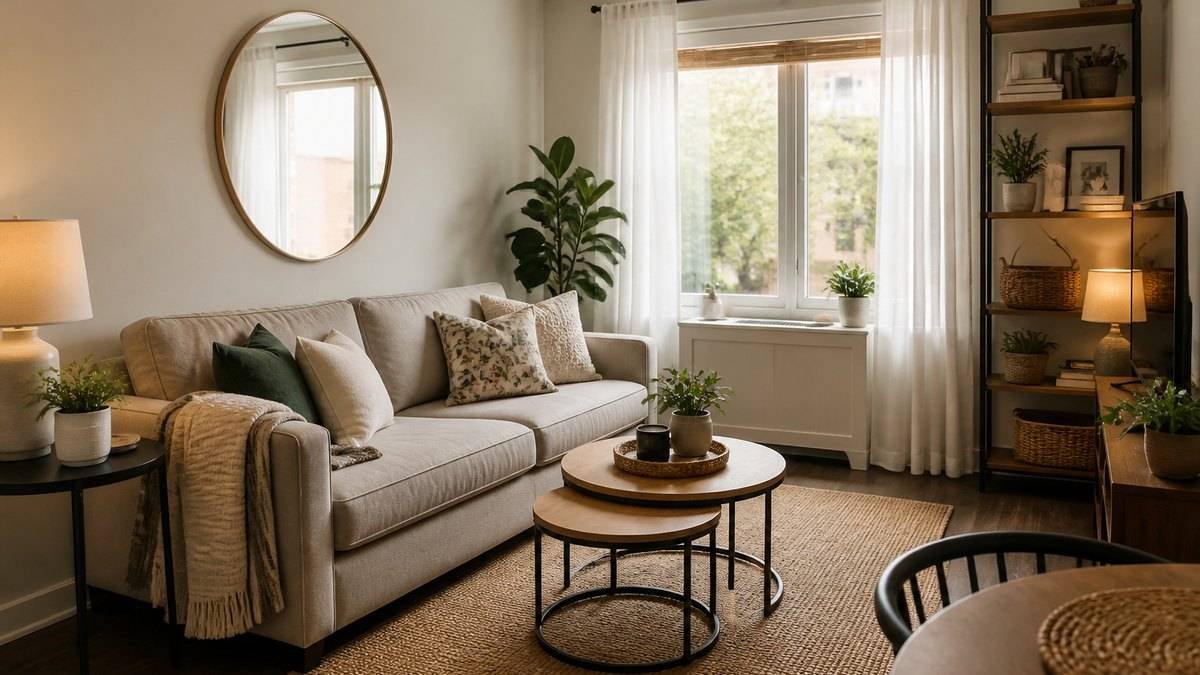
A small living room decorates around scale, light, and fewer, better pieces. The room that feels cramped is not the one with too little space; it is the one with furniture that is too big, too much stuff, and no room for the light to move.
Small living room decor ideas work in the same order every time: fix the scale, make the furniture work twice, open up the light, and edit what is left. The order matters, because a beautiful rug on a cluttered floor is still a cluttered room, and a perfect paint color cannot fix a sofa that blocks the walkway.
Most of the changes below cost under $200, and the whole room turns around over a weekend.
Scale First: Furniture That Fits the Room, Not the Showroom
Measure the room and the walkways before buying anything, then choose furniture that fits both, because the single biggest mistake in a small living room is a sofa or a chair that is one size too large. Scale is the first lever, and it decides whether the room feels open or crowded before a single decoration goes up.
The measuring pass takes ten minutes: the length and width of the room, the width of the doorways, and the path from the door to the seating. Furniture that fits the measurements but blocks the path is furniture that does not fit, and a room that makes people walk sideways feels smaller than it is. The rule of thumb is a clear path of at least three feet, and furniture that leaves it is the furniture to skip.
The sofa is the scale problem in most small living rooms. A full-size sofa that swallows the room is the reason the room feels crowded, and the alternatives are a loveseat, two chairs, or a compact sofa with a shallow depth, all of which leave visible floor. The HGTV designers’ advice holds: in a very small room, four properly scaled chairs can seat more people than one bulky sofa, with room to spare.
For an apartment that is tighter still, the small apartment living room decor ideas on this site walk through the scale rules for the smallest footprints, where every inch of furniture counts twice.
Furniture That Does Double Duty
Furniture that works twice is the second lever: an ottoman that stores, a bench that seats and shelves, a coffee table that lifts, and a sofa bed for guests. Each piece earns its floor space by doing the job of two, and a small room with double-duty furniture needs half the pieces.
The storage ottoman is the highest-value piece for a small living room. It works as a footrest, extra seating, and a toy or blanket bin in one footprint, and it costs $50 to $150. The lift-top coffee table adds a hidden surface for the laptop or the game night, and a bench with storage under the window holds the books or the games while seating guests.
The seating math is where double duty pays off most. A sofa bed turns the living room into a guest room without a second room; nesting tables stack into one footprint when they are not all in use; and a fold-down table against the wall works for the occasional dining without eating the floor. Each piece replaces something that would otherwise take its own floor space.
The rule is that every major piece answers a second question: does this store, seat, or fold? A piece that only looks good is a piece that takes space without earning it, and in a small room that is the definition of crowding.
Light and Color: The Illusion Builders
Light and color are the third lever, and they work as illusions: light colors recede, mirrors double the room, and a painted ceiling raises it. A small living room that feels open is usually one where the walls are light, the window is unblocked, and the light bounces.
The color rule for a small room is one main color plus one accent, kept light on the big surfaces. White, cream, and soft gray walls make the walls recede, while dark walls pull them in, and the same rule applies to the floor and the largest furniture. The accent color lives in the pillows, the rug, and the art, where it adds life without shrinking the room.
The mirror is the cheapest square footage in decorating. A large mirror opposite the window reflects the light and visually doubles the room, and it costs $30 to $80. The ceiling trick works the same way: a ceiling painted a shade lighter than the walls, or left white, reads as higher, and the eye stops at the lighter plane instead of the dark lid.
Natural light is the one element no color can replace. Keep the window treatment minimal, a sheer curtain or none, and pull the furniture back from the window so the light reaches the room. A small living room with light that moves feels bigger than a large one with light that stops at the sill. The small cozy living room ideas on this site take the same light-and-color tricks into the warmer version of the same room.
The Layout: Zones Without Walls
The layout is the fourth lever, and it works by defining zones without walls: a rug anchors the seating, a console separates the entry, and the furniture floats off the walls to let the room breathe. The layout comes before the furniture purchase, because a room that flows needs the pieces placed right before it needs new ones.
The rug defines the seating zone. A rug large enough to hold the front legs of the sofa and the chairs anchors the group and makes the room feel arranged; a rug too small floats the furniture and makes the room feel scattered. The rug is the room’s floor plan in fabric, and choosing it after the furniture is chosen is the order that works.
Floating the furniture is the small-room trick that feels wrong and works anyway. Pushing every piece against the wall leaves a dead center and a cramped ring around the edges; pulling the sofa off the wall by a foot creates a path behind it and a room that feels larger. The same logic applies to the chair: angled toward the sofa instead of squared to the wall makes the seating group read as a room, not a lineup.
For the rooms that share the house’s living space, the family room versions of this layout logic carry the same zones, and the family room decor ideas and the basement family room ideas on this site apply them to bigger footprints and different traffic.
Wall Decor and Vertical Space
Wall decor in a small living room goes high and stays simple: curtains hung near the ceiling make the walls taller, a wall of shelves stores without floor space, and the art hangs at eye level instead of scattered. The walls are the room’s second floor, and a small room that uses them stops needing floor storage.
The curtain height is the free vertical upgrade. Hanging the rod near the ceiling and letting the curtains fall to the floor draws the eye up and makes an eight-foot ceiling read as taller; hanging them at the window frame makes the wall look shorter. The same trick applies to the wall art, which hangs with its center at eye level, roughly 57 to 60 inches, and groups into one deliberate arrangement instead of a scattered few.
The wall of shelves is the storage play for a small room. Floor-to-ceiling shelving on one wall holds the books, the plants, and the display pieces without a single floor-bound cabinet, and it reads as architecture instead of clutter when the shelves stay two-thirds full. The shelf styling follows the same edit rules as the rest of the room: groups of odd numbers, breathing room between the objects, and a third of each shelf left empty.
The wall decor ideas on this site go deeper on the two walls that matter most, with the small living room wall decor guide for the compact room and the family room wall decor guide for the bigger one, and the family room fireplace ideas cover the wall that has a fireplace to work around.
The Edit: What to Leave Out
The final lever is the edit: fewer, better pieces arranged in odd-numbered groups, which is what the 3-5-7 rule in interior design actually means. The rule groups decor in threes, fives, or sevens, because odd groupings read as intentional while even groupings read as accidental, and it applies to every surface in the room.
The 3-5-7 rule is the odd-number grouping principle: three candles on the coffee table, five books on the shelf, seven pieces in the largest arrangement. The eye resolves odd groups into a single deliberate composition, while pairs and fours split into two competing halves. The rule is a design convention, not a law, and the version that matters is the one that stops the surface from being a pile.
The edit has three passes. The first pass removes everything that does not belong in the room. The second pass applies the one-surface rule: the coffee table holds one tray with one group, the mantel holds one arrangement, and the shelves stay two-thirds full. The third pass is the three-item test: if a surface holds more than three kinds of things, it is a collection, and collections need a home that is not the coffee table.
The edit is also where the cool small-room decor ideas live: a single oversized piece of art, one sculptural floor lamp, and one large plant do more for a small room than twenty small decorations, because each one reads clearly instead of getting lost in the crowd.
Decorating on a Budget and in a Rental
Budget and rental decorating follow one rule: spend on what moves with you and save on what stays. The mirror, the rug, the art, and the lighting move, so they get the budget; the paint and the permanent shelves stay, so they get the cheapest version or a renter-friendly one.
The movable pieces are where the money goes. A good rug, a large mirror, and two good lamps change a small living room, and they move to the next apartment intact, so their cost spreads over years instead of one room. The home decor ideas on a budget guide on this site walks through the order of spending when the budget is tight.
The stay-behind pieces get the rental treatment. Peel-and-stick wallpaper on one wall, removable adhesive hooks for the art, and tension-rod curtains avoid the drill holes that cost the security deposit, and the renter-friendly decor ideas on this site cover the full kit of damage-free options. The rule is that nothing permanent goes in without the landlord’s yes, and everything temporary comes out without a trace.
The budget version of the whole method is the same order with a smaller cart: one scaled piece, one double-duty piece, one mirror, and one serious edit. A small living room that is not crowded was never about the budget; it was about the scale, the light, and the things that stayed out.
Frequently Asked Questions
How to Decorate a Very Small Living Room?
Decorate a very small living room by fixing the scale first, choosing furniture that fits the walkways, then making each piece work twice with storage ottomans or lift-top tables. Light walls, a large mirror, and one serious edit finish the room, and most of it costs under $200.
What Is the 3 5 7 Rule in Interior Design?
The 3 5 7 rule in interior design is an odd-number grouping convention: arrange decor in groups of three, five, or seven, because odd groupings read as intentional while even groupings read as accidental. It applies to shelves, tabletops, and mantels, and it is a design convention, not a law.
What Are Some Cool Room Decor Ideas for Small Rooms?
Cool room decor ideas for small rooms include one oversized piece of art, a sculptural floor lamp, a large plant, a floor-to-ceiling shelf wall, and a mirror opposite the window. Each piece reads clearly on its own, which is what makes a small room feel intentional instead of crowded.
What Is the Best Living Room Design for 2026?
The best living room design for 2026 follows the current trend toward warm neutrals, natural materials, and multifunctional furniture, with fewer but better pieces. The direction that holds regardless of the year is the one these ideas are built on: right scale, double-duty furniture, and a serious edit.
Measure the room, pick one double-duty piece, hang a mirror, and edit everything else is the whole method, and it costs about $200. The small living room that feels open was never about adding more; it was about the scale, the light, and the things that stayed out, and that is a room that decorates itself around what is left.
Scale, function, light, edit.